
In the invisible orchestration of modern electronics—from the smartphone in your pocket to the radar in an aircraft—countless components work in harmony at breathtaking speeds. Among these, ceramic capacitors, particularly Multilayer Ceramic Capacitors (MLCCs), have emerged as the undisputed workhorses for high-frequency circuits. While capacitors in general store energy, the unique properties of ceramics make them exceptionally adept at operating in the demanding realms of RF, microwave, and high-speed digital applications. This blog delves into the fundamental reasons why ceramic capacitors are the preferred choice when the frequency dial turns up, exploring the interplay of materials, physics, and design.
The High-Frequency Challenge: Beyond the Ideal Model
At DC or low frequencies, a capacitor behaves largely as an ideal component: a device that blocks DC and passes AC, with its impedance (Xc) simply equal to 1/(2πfC). However, as frequency (f) increases into the MHz and GHz range, this simple model collapses. The physical reality of the component—its parasitic elements—takes center stage.
Every real capacitor is, in fact, a complex network of parasitic resistance (ESR) and inductance (ESL) in series with the ideal capacitance (C), often with some parallel leakage resistance. This forms a series RLC circuit with a critical characteristic: the Self-Resonant Frequency (SRF). At the SRF, the capacitive and inductive reactances cancel each other out, leaving only the ESR. Below the SRF, the device acts as a capacitor; above it, the parasitic inductance dominates, and it behaves like an inductor—a catastrophic failure for a component meant to provide a low-impedance path to ground for noise.
Therefore, suitability for high-frequency applications hinges on three parameters:
-
Low Equivalent Series Resistance (ESR): Minimizes energy loss (heat) and voltage ripple.
-
Low Equivalent Series Inductance (ESL): Pushes the SRF to a higher frequency, extending the useful capacitive range.
-
High Self-Resonant Frequency (SRF): Defines the upper operational limit for effective capacitive behavior.
This is where ceramic capacitors, specifically MLCCs, shine.
The Structural Mastery of the MLCC
The multilayer construction of modern ceramic capacitors is a feat of miniaturization and electrical optimization that directly addresses high-frequency needs.
1. The Inherently Low-ESL Architecture:
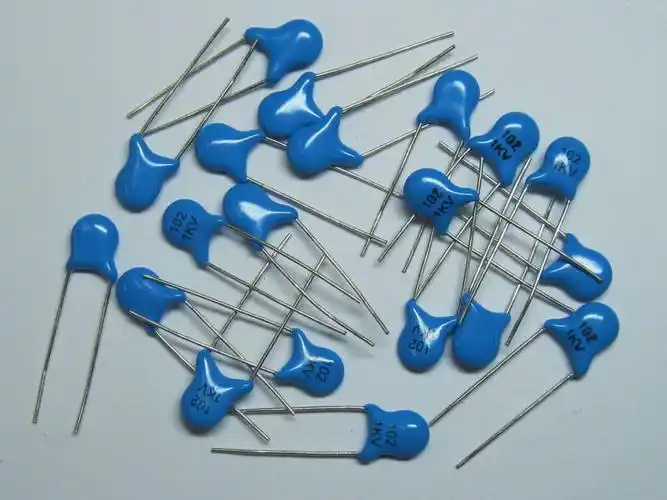
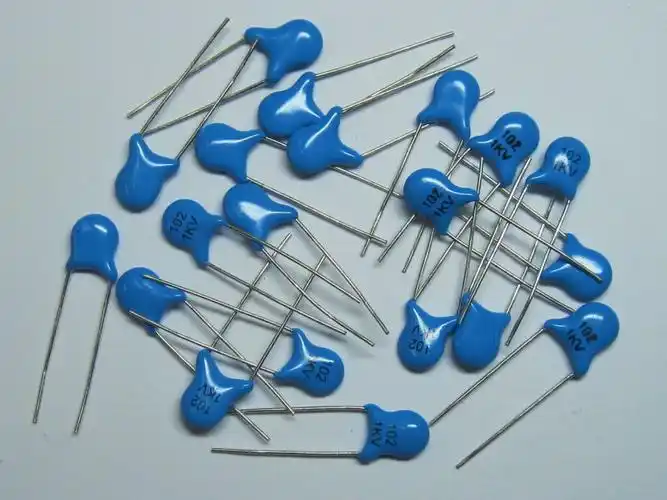
An MLCC is built by stacking hundreds of alternating layers of ceramic dielectric and metal electrode. The electrodes are arranged so that their connections alternate between the two end terminations. This creates a vast array of tiny capacitors connected in parallel. Critically, the current path through this structure is exceptionally short and spread across a wide, parallel plane. Inductance (L) is proportional to the loop area of the current path; the MLCC’s compact, interleaved design minimizes this area, resulting in remarkably low ESL values—often in the range of 0.1 to 0.5 nH for small-case sizes. This is a fundamental advantage over wound designs like tantalum or older ceramic disc capacitors, which have longer, coiled internal paths and thus higher inductance.
2. The Size Advantage:
A direct, though sometimes counterintuitive, correlation exists: smaller ceramic capacitors generally have higher SRFs. Packages like 0201 (0.6mm x 0.3mm) and 0402 (1.0mm x 0.5mm) have minimal internal current paths and lead contributions, allowing them to reach SRFs deep into the GHz spectrum. This makes them perfect for densely packed, high-speed boards in 5G modules, Wi-Fi 6/6E routers, and millimeter-wave sensors.
The Heart of the Matter: Dielectric Material Science
The ceramic dielectric itself is the defining element. Ceramics are broadly classified into three classes, each with distinct high-frequency personalities:
-
Class I (C0G/NP0): The High-Frequency Champions.
Composed of paraelectric materials like magnesium titanate, C0G dielectrics offer near-perfect linearity. Their key attributes for high-frequency use are:-
Exceptional Stability: Their capacitance change with temperature, voltage, and time is negligible (e.g., 0±30ppm/°C).
-
Ultra-Low Loss (High Q): They possess a very low dissipation factor (tan δ), typically < 0.001. This means minimal signal energy is lost as heat, which is critical in RF matching networks, filters, and oscillators where a high Quality Factor (Q) is essential for sharp tuning and low noise.
-
Non-Ferroelectric: They lack a domain structure, eliminating dielectric absorption (soakage) and microphonic effects that can distort signals.
The trade-off is a relatively low dielectric constant (K), limiting their maximum capacitance value in a given size. They are the gold standard for resonant circuits, VCOs, and any application where predictable, stable capacitance is non-negotiable.
-
-
Class II (X7R, X5R) & Class III (Y5V, Z5U): The High-Capacitance Compromise.
Based on ferroelectric barium titanate, these materials are engineered to have very high dielectric constants (K in the thousands), enabling high capacitance in small volumes (e.g., 10µF in a 0603 package). However, this comes at a cost:-
Strong Frequency Dependence: Their capacitance can drop significantly as frequency increases due to the inability of ferroelectric domains to switch fast enough.
-
Higher Loss (Lower Q): Their dissipation factor is orders of magnitude higher than C0G.
-
Non-Linearity: Capacitance varies with applied DC bias voltage and temperature.
While not ideal for precision RF signal paths, high-K Class II MLCCs (like X7R) are the cornerstone of high-frequency power integrity. Their combination of moderately low ESL, small size, and high capacitance makes them superb broadband decoupling capacitors on power rails of digital ICs (CPUs, FPGAs, ASICs), where their job is to suppress high-frequency switching noise from MHz to hundreds of MHz.
-
Winning Applications in the High-Frequency Arena
-
RF Matching & Filtering: C0G MLCCs are indispensable in the RF front-end. Their stability and high Q factor allow for precise impedance matching networks (e.g., in antenna tuners) and stable, low-insertion-loss filters (LC, bandpass) that are essential for signal clarity and receiver sensitivity.
-
Power Supply Decoupling (Bypassing): This is arguably their most critical high-frequency role. A modern processor switches current billions of times per second. A network of MLCCs with varying values (e.g., 100nF, 10nF, 1nF) placed close to the power pins provides a low-impedance path to ground for this switching noise across a wide frequency band. The smallest-value capacitors with the lowest ESL handle the fastest (highest frequency) transients.
-
High-Speed Digital Coupling & Termination: In high-speed serial links (PCIe, USB, HDMI), MLCCs are used for AC coupling, blocking DC bias while allowing the GHz-rate data signal to pass with minimal distortion. They are also used in termination networks to prevent signal reflections.
The Final Verdict: A Comparison
|
Feature |
Ceramic Capacitor (MLCC – C0G) |
Ceramic Capacitor (MLCC – X7R) |
Tantalum (Polymer) |
Film Capacitor (e.g., PP) |
|---|---|---|---|---|
|
Primary HF Strength |
Ultra-low loss, high stability |
Small size, high CV, low ESL |
High capacitance density |
Very stable, low loss |
|
Typical ESL |
Very Low |
Very Low |
Medium |
Low to Medium |
|
SRF Range |
Very High (GHz+) |
High (MHz to GHz) |
Low to Medium |
Medium |
|
Loss (tan δ) |
Extremely Low (<0.001) |
Moderate (0.01 – 0.05) |
Low |
Very Low |
|
Cap. vs. Freq. |
Very Stable |
Degrades significantly |
Stable |
Very Stable |
|
Best For (HF) |
RF signal path, resonators |
Power rail decoupling |
Bulk decoupling (lower freq.) |
High-power RF, precision analog |
Conclusion: Engineered for the Fast Lane
Ceramic capacitors, through their ingenious multilayer design and sophisticated dielectric engineering, are uniquely suited to tame the challenges of high-frequency electronics. C0G types provide the predictable, low-loss behavior required for signal integrity in RF and analog circuits, while high-K X7R types offer the compact, low-ESL bulk charge needed for power integrity in digital systems. Their ability to offer extremely low parasitic inductance, high self-resonant frequencies, and a range of stable-to-compact material options makes them not just suitable, but essential for the functioning of our connected, high-speed world. As frequencies continue to climb with the rollout of 5G/6G and beyond, the evolution of ceramic capacitor technology will remain pivotal in enabling the next generation of electronic innovation.
See Also
IRF820 N-Channel MOSFET: Powering Management, DC-DC, and Motor Control
Unveiling FREESCALE MCF5251CVM140: Essential Features for Automotive Applications
Coilcraft XPL2010 Inductors: High-Performance Solutions for VRM/VRD Designs
NXP Microcontrollers: Driving Automotive Electronics with Core Chip Power
R5F64219JFB Microcontroller: Essential Driver for Audio Equipment Design