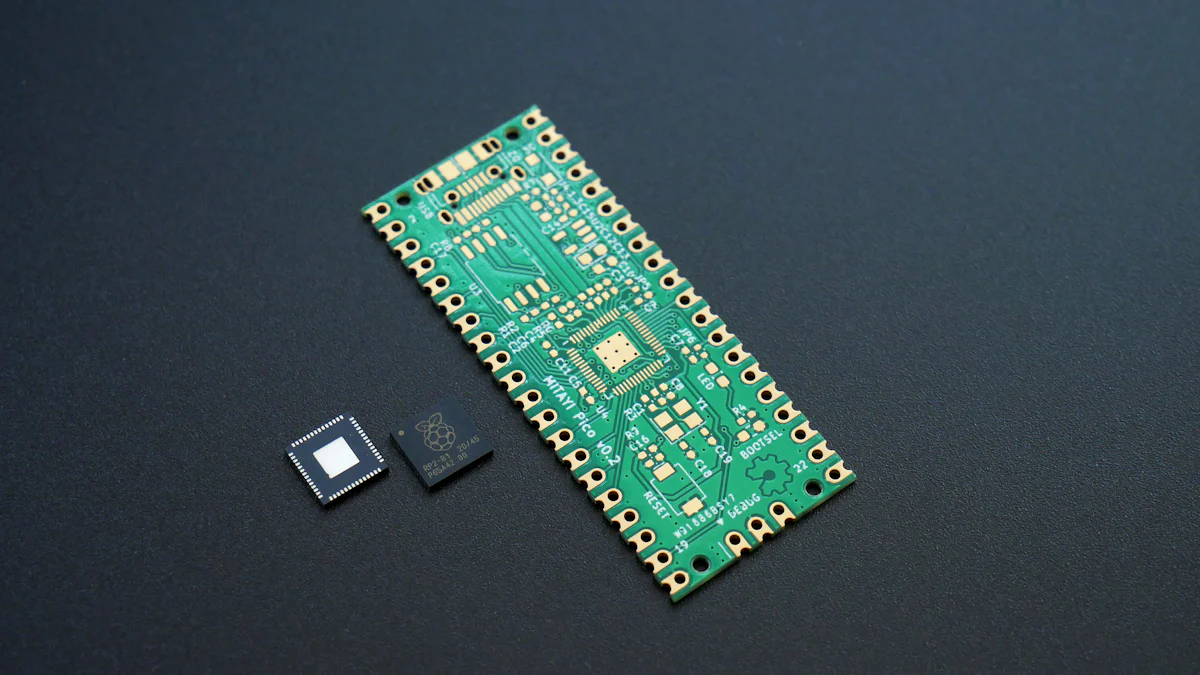
Selecting the appropriate microcontroller unit (MCU) for medical equipment represents one of the most critical decisions in the design process, carrying significant implications for device safety, reliability, regulatory compliance, and long-term viability. The medical electronics landscape demands MCUs that balance computational performance with robust safety features, energy efficiency, and exceptional reliability. In this technical analysis, we examine two capable contenders: the STM32F401VCT6 from STMicroelectronics’ mainstream Cortex-M4 series and the STR750FV2T6 from the company’s specialized ARM7-based family. While both originate from the same semiconductor manufacturer, they represent distinct architectural philosophies tailored to different segments of the embedded market.
This comparative evaluation explores these microcontrollers across multiple dimensions critical to medical applications, including processing architecture, peripheral integration, safety features, power management, and ecosystem support. Understanding their respective strengths and limitations enables design engineers to make informed decisions aligned with specific medical device requirements, whether for portable monitoring equipment, diagnostic instruments, therapeutic devices, or hospital infrastructure components.
Architectural Foundations and Processing Capabilities
STM32F401VCT6: Modern Cortex-M4 Efficiency
The STM32F401VCT6 is built around ARM’s 32-bit Cortex-M4 core, featuring a blend of digital signal processing capabilities and general-purpose computing efficiency. Operating at up to 84 MHz, this processor integrates a single-precision floating-point unit (FPU), significantly accelerating mathematical computations common in medical signal processing applications such as ECG analysis, pulse oximetry algorithms, and respiratory monitoring.
The memory configuration includes 256 KB of Flash memory and 64 KB of SRAM, providing substantial space for complex application code and data buffers. The Harvard architecture with separate instruction and data buses enhances performance by enabling simultaneous access to code and data memory. For medical devices requiring waveform processing or real-time analytics, the DSP instructions and FPU can reduce algorithm execution time by up to 70% compared to software implementations on architectures without these hardware accelerators.
STR750FV2T6: Time-Tested ARM7TDMI Simplicity
Contrasting with the modern Cortex-M4, the STR750FV2T6 employs the classic ARM7TDMI core operating at up to 60 MHz. This venerable processor utilizes the simpler von Neumann architecture with a three-stage pipeline, offering deterministic performance characteristics valued in safety-critical applications. The STR750FV2T6 provides 256 KB of embedded Flash and 16 KB of SRAM, with an additional 8 KB of battery-backed SRAM for critical data retention during power events.
While lacking the mathematical accelerators of the Cortex-M4, the ARM7TDMI core benefits from extensive historical validation in medical and industrial applications. Its straightforward architecture facilitates comprehensive testing and verification, potentially simplifying certification processes for medical devices. The processor’s instruction set includes both 32-bit ARM and 16-bit Thumb modes, allowing code density optimization that can be advantageous in cost-sensitive applications.
Peripheral Integration for Medical Applications
Analog Front-End Capabilities
Medical equipment frequently interfaces with physiological sensors requiring precise analog measurement. The STM32F401VCT6 integrates three 12-bit analog-to-digital converters (ADCs) capable of simultaneous operation at up to 2.4 MSPS, along with two 12-bit digital-to-analog converters (DACs). These converters support multiple simultaneous sampling sequences, beneficial for multi-parameter monitoring devices.
The STR750FV2T6 counters with its own robust analog suite, including a 10-bit ADC with up to 16 channels and a sampling rate of 1.5 MSPS. While offering lower resolution than the STM32F401 variant, it compensates with superior analog input protection and enhanced electromagnetic compatibility characteristics—features particularly valuable in electrically noisy medical environments.
Connectivity and Interface Options
Connectivity represents another crucial differentiator. The STM32F401VCT6 provides comprehensive modern interfaces including USB 2.0 OTG (On-The-Go), three I²C interfaces, four USARTs, five SPI ports, and an SDIO interface. This extensive connectivity suite supports medical device interoperability requirements, enabling communication with hospital networks, wireless modules, and peripheral diagnostic equipment.
The STR750FV2T6 offers a more traditional but medically-relevant interface set, including USB 2.0 Full Speed, CAN 2.0B controllers, multiple USARTs, and SPI interfaces. The inclusion of dual CAN controllers makes this MCU particularly suitable for medical equipment operating in distributed hospital systems where CAN networks remain prevalent for bedside device communication.
Safety and Reliability Features
Hardware Safety Mechanisms
Medical device standards such as IEC 60601-1 and IEC 62304 mandate specific safety requirements that influence MCU selection. The STM32F401VCT6 incorporates several safety-enhancing features including a memory protection unit (MPU), parity checking on Flash memory, and hardware CRC calculation unit. Its dual watchdog timers (independent and window) provide robust fault recovery mechanisms, while the embedded Brown-Out Reset (BOR) ensures reliable operation during power supply fluctuations.
The STR750FV2T6 implements a complementary safety approach with its embedded dual-bank Flash memory supporting read-while-write capability—enabling safe firmware updates without interrupting critical medical functions. The MCU includes a comprehensive clock security system with multiple clock sources and monitoring, plus a backup power domain that maintains essential functions during main power failure.
Regulatory Compliance Considerations
From a regulatory perspective, both MCUs benefit from STMicroelectronics’ documentation support for medical applications. However, the STR750FV2T6 has a longer track record in medically certified equipment, potentially reducing certification uncertainty. Its design includes specific features to mitigate electromagnetic interference (EMI), a common challenge in medical environments where multiple electronic devices operate in proximity.
The STM32F401VCT6, while newer, benefits from the extensive certification of the STM32 family across industrial and medical applications. Designers should evaluate which platform offers the more straightforward path to compliance based on their specific device classification and target markets.
Power Management and Energy Efficiency
Dynamic Power Consumption
Portable and wearable medical devices demand exceptional energy efficiency to maximize operational time between charges. The STM32F401VCT6 implements multiple power-saving modes including Sleep, Stop, and Standby, with the latter consuming approximately 2.4 µA while maintaining SRAM and register contents. Its dynamic power consumption at maximum frequency is approximately 240 µA/MHz, with the FPU and peripherals featuring independent clock gating for fine-grained power management.
The STR750FV2T6 offers competitive low-power performance despite its older architecture, with Stop modes consuming as little as 15 µA and Deep Sleep mode reducing consumption to 2 µA. While its dynamic efficiency lags behind the Cortex-M4 implementation, the STR750’s simpler core can sometimes achieve lower overall system power in applications that don’t require continuous high-performance computation.
Battery-Powered Operation Considerations
For battery-powered medical devices, both MCUs offer integrated features to extend operational life. The STM32F401VCT6 includes a dedicated battery backup domain and voltage regulator with programmable scaling, allowing dynamic adjustment of power consumption based on processing requirements. The STR750FV2T6 incorporates a similar backup domain with additional emphasis on data retention during extended power loss scenarios.
Development Ecosystem and Long-Term Support
Software Tools and Middleware
The STM32F401VCT6 benefits from the expansive STM32Cube ecosystem, including hardware abstraction layers, middleware libraries, and the STM32CubeMX configuration tool. This ecosystem significantly accelerates development, with specific medical-oriented software components available including safety libraries, digital filter implementations, and connectivity stacks. Support for real-time operating systems (RTOS) like FreeRTOS, Azure RTOS, and SafeRTOS facilitates the development of complex medical devices with safety certification requirements.
The STR750FV2T6 utilizes a more traditional development approach with comprehensive peripheral libraries and example code. While its ecosystem is less extensive than the STM32 family, it offers stability and mature tools that some medical device manufacturers prefer for long-lifecycle products. The MCU is well-supported by major toolchains including IAR Embedded Workbench and Keil MDK, both offering certification kits for medical applications.
Longevity and Supply Chain Considerations
Medical equipment typically has longer product lifecycles than consumer electronics, sometimes exceeding 10-15 years. Both MCUs are positioned as long-lifecycle products, but the STR750FV2T6 has demonstrated exceptional longevity in the market. The STM32F401VCT6 benefits from the massive scale of the STM32 family, suggesting strong continued availability, though its relative newness means a shorter proven track record.
Designers must consider not just current availability but also second-source options and migration paths. The STM32 family offers extensive pin-to-pin and software compatibility across performance grades, while the STR750 series represents a more specialized solution with fewer direct migration options.
Application-Specific Recommendations
High-Performance Medical Devices
For medical equipment requiring substantial computational performance—such as portable ultrasound systems, advanced patient monitors with multiple parameter analysis, or infusion pumps with complex safety algorithms—the STM32F401VCT6 represents the superior choice. Its Cortex-M4 core with FPU accelerates mathematical computations, while the extensive peripheral set supports complex user interfaces and connectivity requirements. The MCU’s performance headroom also accommodates future feature enhancements without hardware redesign.
Safety-Critical and Long-Lifecycle Equipment
In applications prioritizing maximum reliability, safety certification simplicity, and proven performance—such as implantable device programmers, critical care ventilators, or surgical power tools—the STR750FV2T6 offers distinct advantages. Its simpler architecture facilitates comprehensive testing, while the extensive field history reduces regulatory uncertainty. The dual-bank Flash architecture enables safe over-the-air updates, increasingly important for connected medical devices.
Cost-Sensitive and Moderate-Performance Applications
For medium-complexity medical devices where cost optimization is essential—including basic patient monitors, thermometry systems, or medical pneumatic controls—the selection becomes more nuanced. The STM32F401VCT6 may offer better value through its higher integration and potential for system cost reduction, while the STR750FV2T6 might prove advantageous in applications requiring specific legacy interfaces or benefiting from its enhanced noise immunity characteristics.
Conclusion
The selection between STM32F401VCT6 and STR750FV2T6 for medical equipment hinges on specific application requirements, performance needs, safety considerations, and development constraints. The STM32F401VCT6 represents a forward-looking choice with superior computational performance, modern development ecosystem, and extensive peripheral integration suited to next-generation medical devices. Its Cortex-M4 architecture with DSP extensions particularly excels in applications requiring signal processing or complex algorithms.
Conversely, the STR750FV2T6 offers a proven, robust solution with extensive medical application history, simplified certification pathways, and deterministic performance characteristics valued in high-reliability medical systems. Its traditional architecture, while less computationally capable, provides transparency and verifiability that can accelerate safety certification.
Ultimately, medical device designers must perform a thorough requirements analysis weighing computational needs against safety, reliability, power, and lifecycle considerations. Both MCUs represent capable solutions within their respective domains, and the optimal selection aligns technical capabilities with specific medical application demands, regulatory environment, and total product lifecycle strategy. As medical technology continues evolving toward greater connectivity and intelligence, while maintaining uncompromising safety standards, such careful MCU selection remains fundamental to successful medical device design.
See Also
Dependable Option for Medical Integrated Circuits
Investigating MC9S12DJ256MFUE Specs for Auto Uses
Best 3 ECU Features of SPC5605BMLL6 and SPC5607BMLL6
3 Effective Methods to Implement MC9S12XET512VAG
Enhancing Car Performance with NXP Microcontrollers